

Why Am I Always Monitoring Everyone Else’s Mood?
You walk into the room and immediately know.
Your partner is stressed. One of your kids seems irritated. Someone is unusually quiet.
The energy in the room just feels different.
And before anyone has even said anything, you’re paying attention.
Is everything okay? Did I do something? Is this going to become a problem? Should I ask what’s wrong? Should I give them space?
Many women become so good at noticing everyone else’s emotional state that they don’t realize how much energy they’re spending doing it.
You may think of yourself as perceptive, empathetic, caring, or simply good at reading people.
And you probably are.
However, there’s an important difference:
Noticing someone else’s emotions is not the same as being responsible for them.
For women who struggle with anxiety, overthinking, people-pleasing, or past relationship experiences, another person’s mood can quickly become something their own nervous system feels responsible for managing.
Over time, that can be exhausting.
Why Am I So Aware of Everyone Else’s Mood?
There isn’t one reason women become highly attuned to the emotions of everyone around them.
Sometimes It Starts Early
For example, you grew up in a home where someone’s mood affected the entire household.
You learned to notice subtle changes in tone, facial expressions, body language, or energy because knowing how someone felt helped you know what might happen next.
Sometimes It Comes From Past Relationships
This pattern can also develop after an unpredictable or emotionally difficult relationship.
Your brain becomes very good at noticing changes because, at one point, noticing those changes felt important.
Anxiety Can Strengthen the Pattern
In addition, anxiety can make you even more likely to scan for changes.
When your brain is already prone to asking “What if something is wrong?”, another person’s mood can quickly become something to analyze.
And then there is the emotional load many women carry.
You may be the person who remembers what everyone needs, manages schedules, worries about the kids, supports your partner, keeps things moving at work, checks on family members, and notices when someone isn’t quite themselves.
As a result, after years of paying attention to everyone else, your brain becomes incredibly practiced at asking:
“How is everyone doing?”
But much less practiced at asking:
“How am I doing?”

When Being Emotionally Aware Becomes Hypervigilance
Being able to read people isn’t a bad thing.
In fact, empathy, compassion, and emotional awareness are strengths.
However, sometimes that awareness turns into emotional hypervigilance.
Instead of simply noticing someone’s mood, your nervous system begins reacting to it.
Does This Sound Familiar?
Your partner walks through the door stressed.
Your body tightens.
Your teenager answers you differently.
You immediately wonder what’s wrong.
Someone seems irritated.
You replay your last interaction to figure out whether you caused it.
A family member is overwhelmed.
You start figuring out what you can do to make things easier.
Eventually, you’re no longer simply noticing how everyone feels.
You’re carrying it.
Why Does Someone Else’s Mood Affect Me So Much?
Women often come to therapy saying:
“I know logically that it’s not my responsibility, but I still feel it.”
That’s an important distinction.
You can intellectually understand that your partner is simply stressed from work or that your teenager is allowed to be in a bad mood.
But your body may still react as though something needs your attention.
You might notice:
-
-
- Tightness in your shoulders or chest
- A sinking feeling in your stomach
- Restlessness or anxiety
- Irritability
- An urge to fix the situation
- An urge to get away from the person
-
Your Body May Notice Before Your Brain Does
This is something I talk about often in therapy:
The body frequently reacts before our thinking brain catches up.
For instance, your mind may say:
“They’re just stressed.”
Meanwhile, your nervous system is saying:
“Pay attention. Something changed.”
That’s why simply telling yourself to stop worrying about it doesn’t always work.
Instead, sometimes we need to help the body learn something new:
Am I Noticing Their Feelings—or Managing Them?
So, how can you begin to recognize when this is happening?
One of the most helpful questions you can ask yourself is:
Am I noticing this person’s feelings, or am I trying to manage them?
Someone you love can be stressed without you fixing their stress.
They can be disappointed without you making it better.
They can be quiet without you figuring out why.
They can have a bad day without you rearranging yours.
And someone can even be irritated without you immediately determining whether you caused it.
In other words:
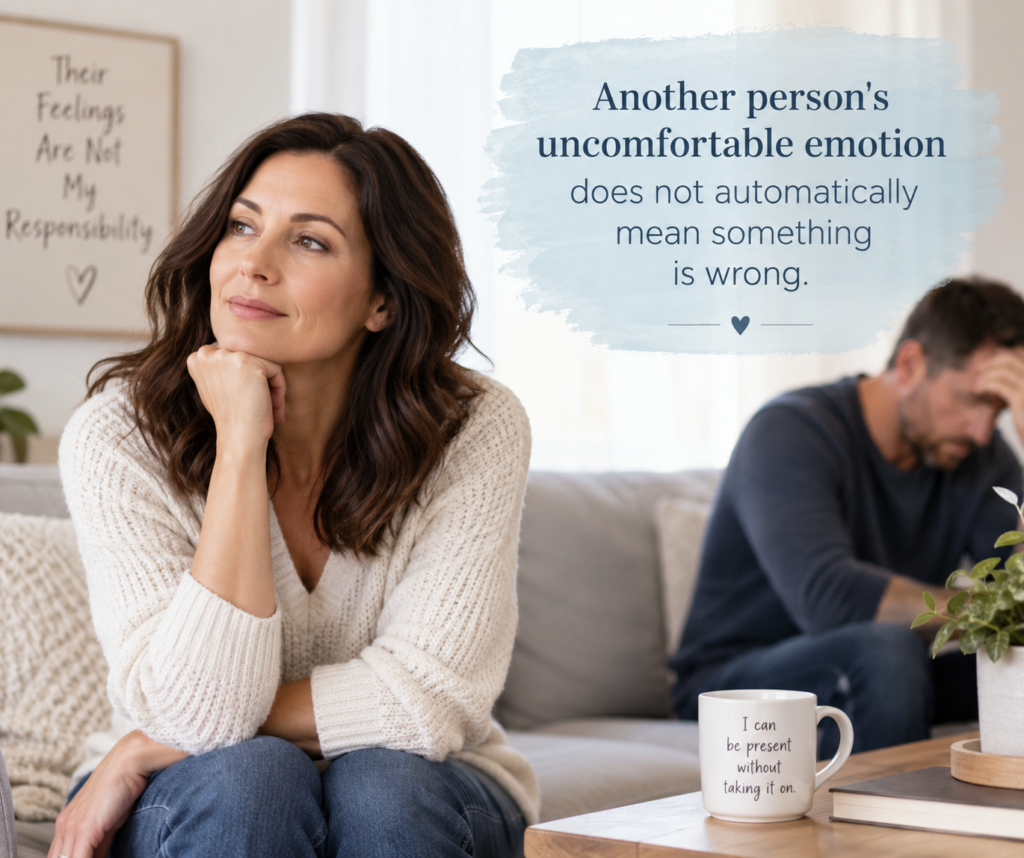
Other people’s emotions are information. They are not automatically instructions.
That doesn’t mean you stop caring.
Instead, it means recognizing that caring about someone and being responsible for their emotional state are two very different things.
The Invisible Emotional Load Many Women Carry
Of course, these patterns don’t happen in isolation.
Many women become the emotional center of their families without even realizing it.
You’re thinking about what needs to happen tomorrow while handling what needs to happen today.
You’re remembering appointments, noticing changes in your children, thinking about your relationship, managing work responsibilities, and anticipating what might go wrong.
Meanwhile, you may be managing everyone else’s needs so automatically that you don’t realize how little attention is left for you.
Over Time, You May Notice:
- Anxiety and overthinking
- Irritability
- Resentment
- Emotional exhaustion
- Difficulty relaxing
- Feeling responsible for everyone
- Losing touch with your own needs
Eventually, you may even find yourself wanting distance from the people you love.
Not because you don’t want connection.
Rather, being around other people’s emotions may begin to feel like one more thing your nervous system has to manage.
Sometimes you want distance because being around other people’s emotions feels like one more thing your nervous system has to manage.
Learning to notice what’s happening inside of you—not just everyone around you—can be an important part of reducing anxiety and emotional overload.
“What has my nervous system learned—and what do I want to teach it now?”
You Can Care Without Carrying It
Ultimately, the goal isn’t to become less empathetic.
It isn’t to stop noticing the people you love.
And it isn’t to become indifferent when someone is struggling.
Rather, the goal is learning where their emotional experience ends and yours begins.
You can be compassionate without becoming responsible.
You can offer support without trying to control the outcome.
You can notice tension without assuming something bad is about to happen.
Counseling Services We Offer in Columbia, White Marsh & Virtual Platforms
Finding the right therapist is about more than finding someone with the right credentials. You need someone they can connect with, trust, and feel comfortable talking to. At Crystal Waters Counseling Centers, we will provide a safe and supportive space to process life’s events and assist you in making efforts to move forward into peace from uncomfortable emotions and negative thinking patterns. Our Columbia, White Marsh & Virtual therapists for teens offer a person-centered holistic approach to meeting your counseling needs. In order to get started in counseling for teens follow these simple steps.
- Reach out to speak with a specialized therapist.
- Schedule your first appointment at Crystal Waters Counseling Centers
- Help your teen start living a life free of stress, anxiety, and depression.
Other Counseling Services We Offer in Columbia, White Marsh & Virtual Platforms
We offer services online throughout Maryland or in person at our Columbia, White Marsh & Virtual Platforms in MD. Additionally services include depression treatment, EMDR, therapy for college students, life transitions, and parenting and educational consultation. We look forward to supporting you.